
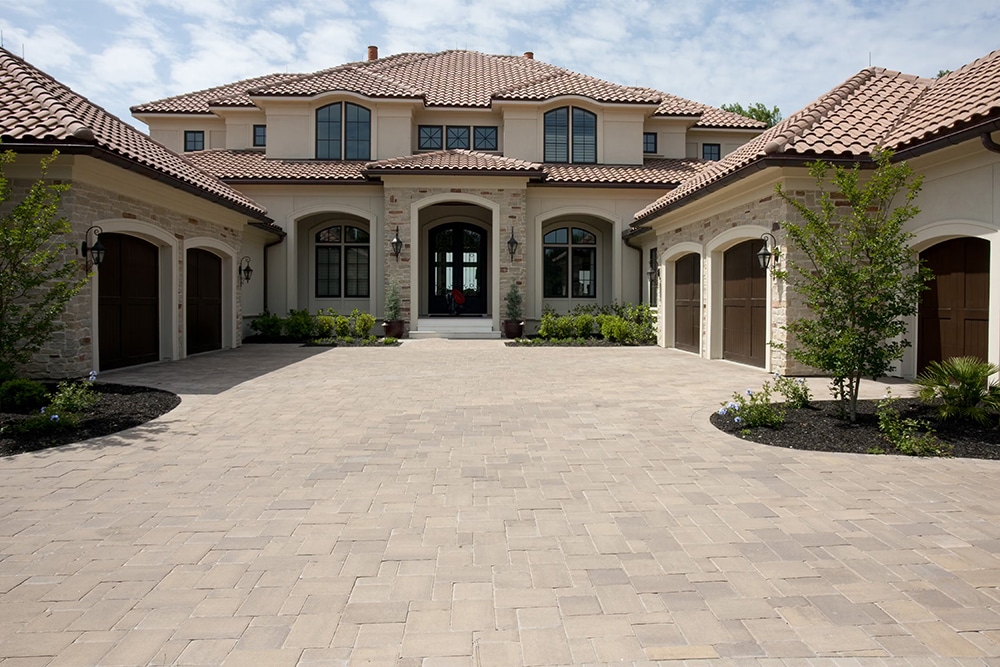
When you’re planning a new driveway for a home in Bluffton, Hilton Head Island or elsewhere in the South Carolina Lowcountry, the material you choose has to do more than look good. It needs to stand up to intense summer heat, heavy rainfall, humidity and the soil conditions that come with living near the coast.
Two of the most popular options are paver driveways and poured concrete driveways. Both can provide a durable surface, but they perform differently over time. Understanding those differences can help you choose the driveway that’s right for your home, budget and long-term plans.
Paver Driveways vs. Concrete Driveways at a Glance
| Feature | Paver Driveway | Concrete Driveway |
|---|---|---|
| Appearance | Wide variety of colors, patterns and styles | Clean, simple appearance |
| Upfront Cost | Typically higher | Typically lower |
| Repairability | Individual pavers can be replaced | Cracks can be difficult to repair seamlessly |
| Movement | Individual units allow some flexibility | Large rigid slabs are more susceptible to cracking |
| Customization | Extensive | More limited with standard concrete |
| Maintenance | May require occasional joint maintenance | Relatively low routine maintenance |
| Curb Appeal | High-end, customized appearance | Traditional appearance |
| Installation | Requires careful base preparation and installation | Requires proper grading, forming and curing |
How Does the Lowcountry Climate Affect a Driveway?
Driveways in the Lowcountry face conditions that homeowners in other parts of the country don’t necessarily have to consider.
Bluffton and Hilton Head Island experience hot, humid summers and substantial rainfall. Coastal soils, drainage conditions and tree roots can also affect the ground beneath a driveway.
That makes proper site preparation and drainage just as important as the surface material itself. Even a premium driveway material can develop problems if water isn’t properly directed away from the area or the underlying base isn’t prepared correctly.
Are Pavers Better for Lowcountry Conditions?
One advantage of a properly installed paver driveway is that it consists of many individual units rather than one large, rigid surface.
If minor ground movement occurs, pavers have more ability to accommodate that movement. If an individual area eventually settles or becomes damaged, the affected pavers can often be removed, the base corrected and the same pavers reinstalled.
That’s particularly useful in a region where heavy rainfall, drainage and soil conditions can influence hardscaped surfaces over time.
Pavers also make it easier to address underground work. If access is ever needed to utilities beneath part of the driveway, pavers can potentially be removed and reinstalled instead of requiring a section of concrete to be cut out.
What About Concrete?
Concrete remains popular for good reason. It creates a strong, functional driveway and generally costs less upfront than a comparable paver installation.
For homeowners primarily concerned with creating a durable driveway at a more economical initial cost, concrete may make sense.
The primary drawback is that concrete is a rigid material, and concrete can crack. Proper installation, reinforcement, control joints and site preparation can help manage cracking, but they cannot guarantee that a concrete driveway will remain crack-free indefinitely.
Once cracking does occur, repairs may remain visible. Matching the appearance of older and newer concrete can also be difficult.
Which Driveway Looks Better?
This one largely comes down to the home.
Concrete provides a simple, understated surface that can work with virtually any architectural style. Pavers provide considerably more design flexibility.
Pavers are available in different sizes, shapes, colors, textures and laying patterns. Borders and contrasting elements can also be incorporated to define the driveway or complement other architectural features.
For Lowcountry homes where outdoor spaces are an important part of the property’s overall design, a paver driveway can become an extension of the home’s architecture rather than simply a place to park cars.
A thoughtfully designed driveway can also coordinate with walkways, front entrances, patios, pool areas and other hardscaping, creating a more cohesive exterior.
Do Pavers Get Hotter Than Concrete?
Both concrete and pavers can become hot under the South Carolina summer sun.
Surface temperature depends on several factors, including the material and especially its color. Darker surfaces generally absorb more solar energy, while lighter-colored materials tend to remain comparatively cooler.
This can be worth considering when choosing pavers for areas where people frequently walk barefoot, particularly if the driveway connects to a patio or pool area.
Which Requires More Maintenance?
Neither option should require constant attention when properly installed.
Concrete may occasionally need cleaning and sealing depending on the type of installation and finish. Cracks should also be monitored so they don’t develop into larger problems.
Paver driveways may need occasional cleaning, joint maintenance or resetting if individual areas settle. Depending on the paver system, sealing may also be used to enhance color or make certain types of staining easier to manage.
The significant difference comes when repairs are necessary.
With pavers, individual units can generally be removed and replaced. With concrete, repairing one section without leaving evidence of the repair can be more challenging.
What About Weeds Between Pavers?
A professionally installed paver driveway isn’t simply a collection of bricks placed on the ground.
The installation involves preparing and compacting the base, installing the pavers correctly and filling the joints with an appropriate jointing material. Proper installation helps create a stable surface and minimizes opportunities for weeds to establish themselves.
Occasional weeds can still appear as organic material accumulates in joints over time, but routine maintenance can help keep them under control.
Which Is More Affordable?
Concrete generally wins on upfront price. A standard poured-concrete driveway will usually cost less initially than a professionally installed paver driveway.
Pavers require more materials and labor because each unit must be installed as part of an engineered system.
But initial price isn’t the only consideration.
Homeowners planning to stay in their property for many years may also want to consider repairability, appearance, maintenance and how easily portions of the driveway can be restored if settling or underground work occurs.
Rather than asking which driveway is simply cheaper, it can be more useful to ask:
Which driveway provides the best long-term value for your particular property?
Can You Replace a Concrete Driveway With Pavers?
Yes. An aging, cracked or dated concrete driveway can be removed and replaced with a new paver system.
This can also be an opportunity to reconsider the driveway’s overall design. Depending on the property, homeowners may be able to incorporate a decorative border, redefine the entrance, coordinate the driveway with existing hardscaping or improve drainage as part of the project.
Before beginning, the existing site should be evaluated to determine what’s happening beneath the current driveway. Simply replacing the surface without addressing underlying drainage or base problems can allow those problems to return.
So, Which Is Better for a Bluffton or Hilton Head Home?
There isn’t one answer for every property.
Concrete may be the better choice if your priority is keeping the initial investment lower and you prefer a simple, traditional driveway.
Pavers may be the better choice if you’re looking for greater design flexibility, easier localized repairs and a driveway that contributes more significantly to the curb appeal of your home.
In the Lowcountry, we’d also put considerable weight on something homeowners don’t always see when comparing driveway materials online: the installation beneath the surface.
Proper grading, drainage and base preparation play a major role in how well either driveway performs.
Thinking About a New Driveway?
Quality Hardscapes & Porch Masters designs and installs hardscaping for homes throughout Bluffton, Hilton Head Island and the surrounding South Carolina Lowcountry. Whether you’re considering a new paver driveway or replacing an existing outdoor surface, the first step is evaluating the property, drainage, design and how the new driveway will work with the rest of your home’s exterior.
Ready to explore your options? Contact us today.